
Nike & It Is Not The Shoe Either
(Source: The Louvre) The Winged Victory of Samothrace, also known as the Niké of Samothrace, is a votive monument originally discovered on the island of Samothrace in the northeastern Aegean Sea. It is a masterpiece of Greek sculpture from the Hellenistic era, dating to the beginning of the 2nd century BC (190 BC).
It is composed of a statue representing the goddess Niké (Victory), whose head and arms are missing. Its base is in the shape of a ship's bow. The total height of the monument is 5.57 meters (18 ft 3 in), including the socle; the statue alone measures 2.75 meters (9 ft 0 in).
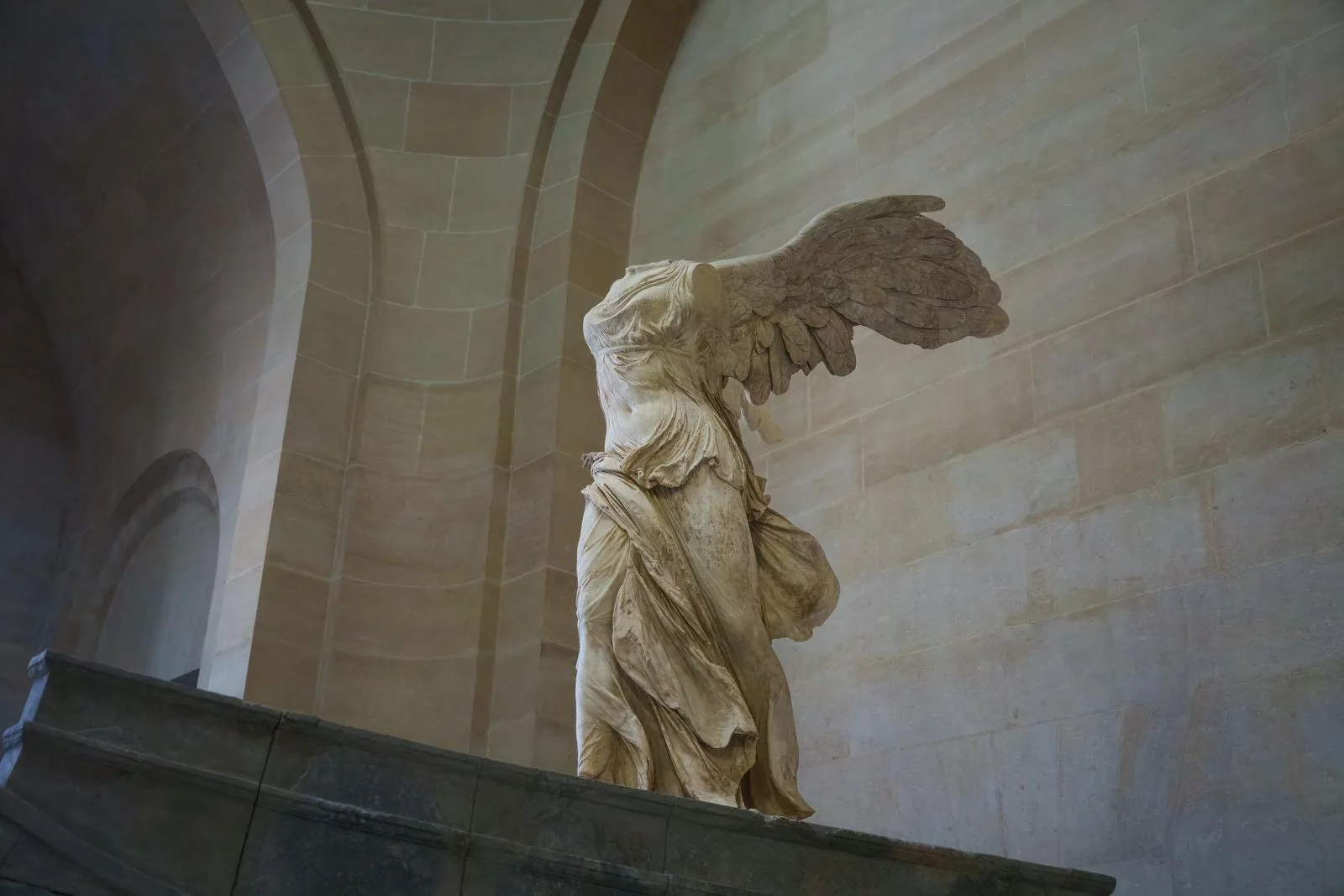
Winged Victory at the Louvre in Paris, France. Click here to see licensing and purchase options
The sculpture is among a small number of major Hellenistic statues surviving in the original rather than as Roman copies. Winged Victory has been exhibited at the Louvre in Paris, at the top of the main staircase, since 1884.[3] Greece is seeking the sculpture's return.
Seeing and photographing Nike/The Winged Victory is a visual charge to the soul. The thought that this much of the sculpture has survived since 190 BC is a reminder of why history is essential. We can visualize the past, gaining a deeper understanding of artistic culture and history.
“For nothing in the world would I want to see the Colosseum rebuilt, with all the walls and steps in perfect condition, or a Parthenon painted in bright colors, or a Victory of Samothrace with her head.” (Matilde Asensi)